




The Ergonomic Truth: How Sitting Impacts Your Spine — and the Professional Solution
In today’s knowledge economy, most professionals spend more than seven hours a day seated at a desk. What seems like a normal working posture is, in fact, one of the most physically demanding positions for the human spine.
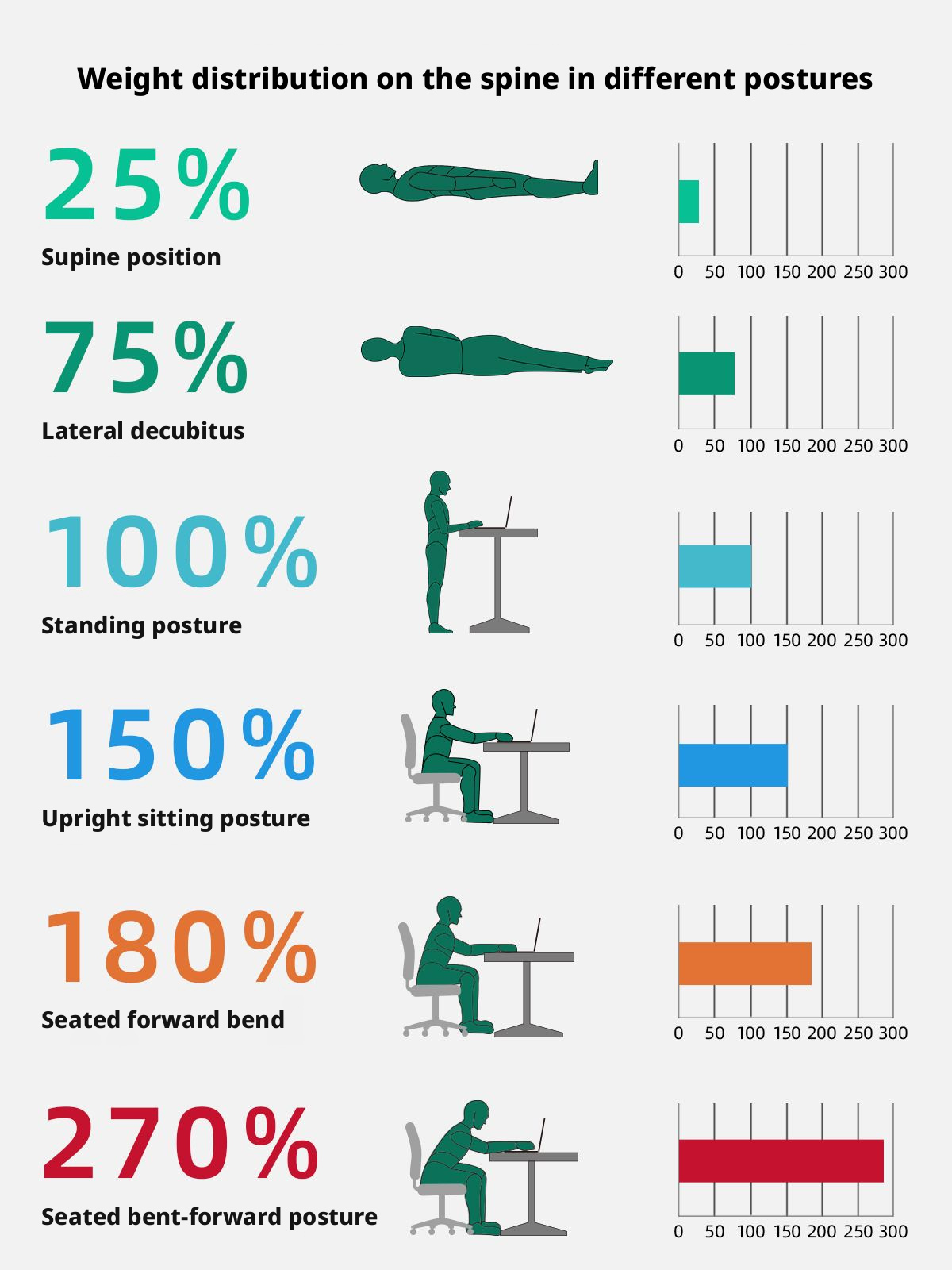
Biomechanical research consistently shows that sitting places significantly higher compressive loads on the lumbar spine than standing. When you sit upright, the pressure on your intervertebral discs rises to approximately 150% of the standing baseline. If you lean forward — a common posture while typing or reading — that number climbs to 180%. And in a slouched, forward-bent sitting position, spinal pressure can reach 270%, nearly three times what your spine is designed to handle.
- Standing: 100%
- Upright sitting: 150%
- Forward leaning: 180%
- Slouched sitting: 270%
This mechanical overload is a primary contributor to chronic lower back pain, early disc degeneration, and fatigue — issues that directly affect employee wellbeing, concentration, and long-term productivity.
The good news is that the solution does not require complex rehabilitation or expensive equipment. Simply standing up and working at the correct height immediately reduces spinal load to its natural baseline of 100%.
Standing also activates postural muscles, improves circulation, and increases alertness — physiological benefits that translate directly into better work performance.
But standing alone is not enough. The desk height must be precisely matched to the user’s body.
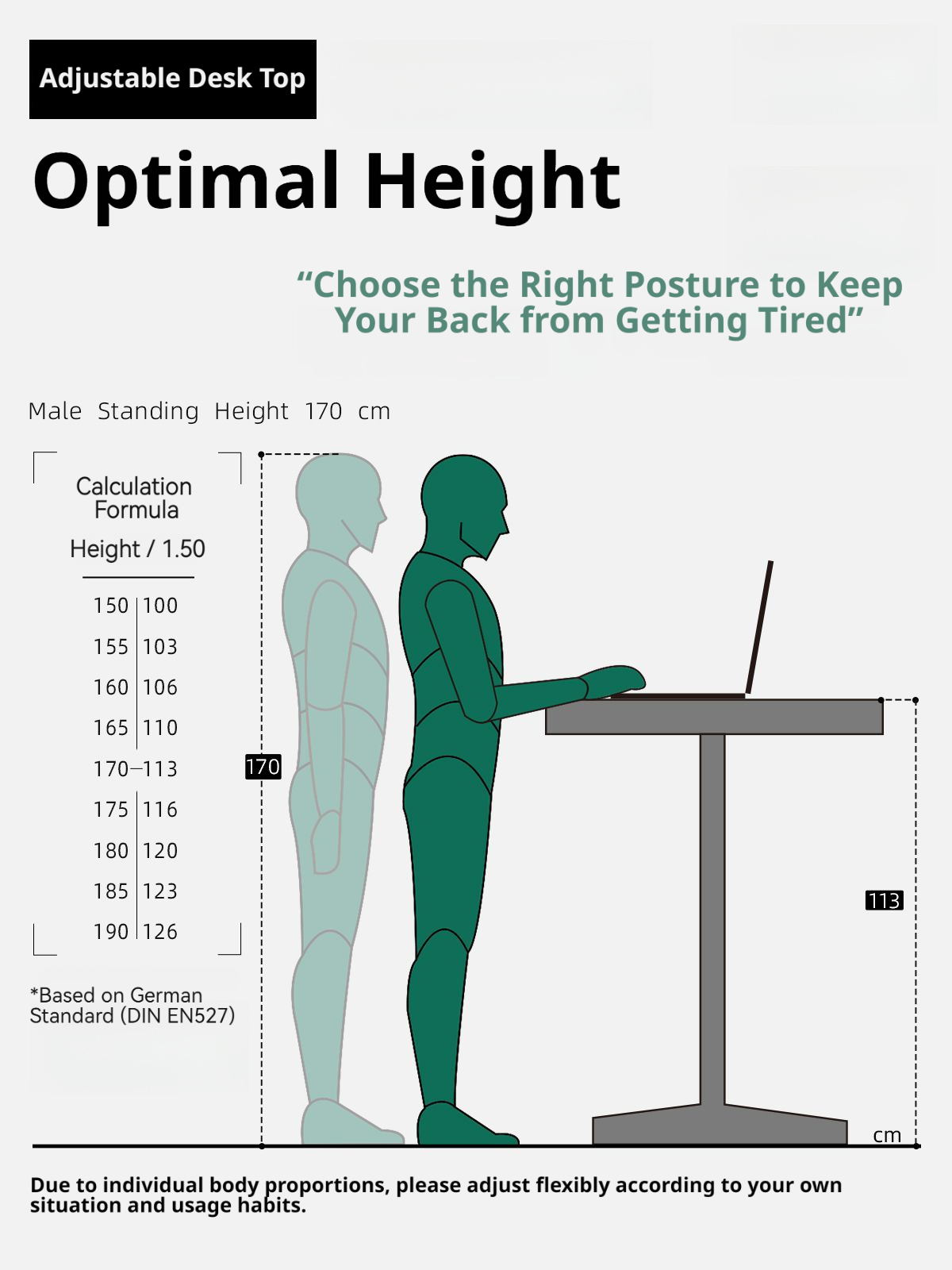
The German standard DIN EN527 provides a clear, evidence-based formula for ideal standing desk height:
Desk height (cm) = Body height (cm) ÷ 1.50
Examples:
- Height 170 cm → desk height ≈ 113 cm
- Height 180 cm → desk height ≈ 120 cm
- Height 160 cm → desk height ≈ 106 cm
This formula ensures a neutral shoulder, elbow, and wrist posture, reducing strain on the upper body as well. No guesswork. No complicated tables. Just a reliable engineering rule.
A common misconception is that standing all day is the goal. In fact, static standing for prolonged periods also creates fatigue and venous stress.
The scientifically recommended work pattern is dynamic alternation:
- Switch between sitting and standing every 30 to 60 minutes
- Allow the spine to experience varying load levels throughout the day
- Keep muscles engaged without overloading any single tissue
This is where electric height-adjustable desks offer a clear advantage over manual or fixed solutions.
From a business perspective, the cost of poor ergonomics is well documented: increased sick leave, lower cognitive performance, and higher turnover rates.
Conversely, providing sit-stand workstations is a proactive health investment. Studies indicate that within three to six months, users report reduced back pain, higher energy levels, and improved concentration. Over a multi-year horizon, the return on investment — in terms of productivity and employee satisfaction — substantially exceeds the initial equipment cost.
For individual professionals, an electric standing desk is equally valuable. It transforms your home office into a long-term health asset, not just a place to get work done.
At the end of the day, your spine was not designed for all-day sitting — nor all-day standing. It was designed for movement and variation.
An electric standing desk gives you the freedom to move, the precision to work at the correct height, and the convenience to switch postures effortlessly.